


Most law firms now say they “use AI.”They’ve bought licences, run a few pilots, and maybe even put “AI strategy” ina partner’s title. But a small, fast‑growing group is doing something far more radical: they’re rebuilding the law firm itself around AI as the core engine ofservice delivery. These are the AI‑native law firms now being tracked in a newglobal index, and their numbers have quietly passed 40 worldwide.
Instead of treating AI as an add‑on tool, these firms let it handle the first draft, the first review, even thefirst client interaction—while human lawyers step in as editors, strategists,and trusted advisors. For clients, that means work can keep moving while thelawyer is asleep or in court. For the rest of the profession, it raises asharper question: are you just dabbling in AI, or are you ready for a worldwhere your competitors are built on it?
Even if you are keeping a slightesttrack of what’s going on in the legal markets, ‘AI-native Law Firm’ is the term you must have come across. There exist a ‘AI-native Law Firm’ Index, a publicdirectory of law firms and legal service providers that are built around AI from the ground up, not just “using a few AI tools on the side.” It has just passed 40 listed firms globally, which is why it is getting attention in thelegal tech press.
What the AI-native Law Firm Index is?
A curated online directory of “AI-native” law firms and legal service providers, created by Lupl co‑founder Matt Pollins and launched inMarch 2026. Theindex focuses on firms whose intake, workflows, pricing, and delivery arefundamentally designed around AI-enabled processes, rather than traditionalworkflows with AI added as an afterthought. It is searchable by region and usecase, so users can browse firms based on geography and type of legal work(e.g., contracts, small claims, startup support).
In short, it is trying to define and track a new category of legal provider that looks and operates differently from traditionalfirms.
What the AI-native Law Firm Index offers?
For users (in‑house counsel, founders, legal ops):
- A centralized list of AI-native law firms and legal providers, which would otherwise be hard to discover because they’re small, new, and globallyscattered.
- Quick comparison of firms by region and by service model (e.g., fixed-fee contractreview, small-claims automation, startup-focused legal bundles).
- Examples of pricing models: many AI-native firms publish transparent price lists online and/or allow you to get a real-time quote via an AI assistant rather than along scoping call.
For law firms and legal innovators:
- A signaling and marketing mechanism: being listed frames the firm as genuinelyAI-native, not just “we bought Harvey.”
- A peer group and benchmark: it shows how other firms are redesigning intake,staffing, and pricing around AI, which is valuable for innovation teams.
Why legal professionals should know about it?
- It reflects a structural change in how some legal services are being designed,priced, and delivered, with AI doing the first pass on work and humansescalating edge cases.
- It shows emerging competition: small AI-native teams are attempting to outcompetelarge incumbents on speed, transparency, and cost, especially for high‑volume, process-heavy work likecontracts and claims.
- It offers concrete models for “what AI-native actually looks like” in practice,which can guide strategy for traditional firms and in‑house teams.
If “using AI” is like adding navigation to a normal car, an AI-native firm is designed as anautonomous‑ready vehicle from day one.
What qualifies as an “AI‑native” law firm
From multiple expert definitions and commentary:
An AI‑native law firm has AI as its foundation: AI is embedded into most or all of what the firm does (intake,drafting, task routing, pricing, delivery), not just in isolated tasks. You can think of it as a services‑and‑software company that happens to be structured like a law firm, rather than a traditional partnership thatmerely licenses AI tools. Typical features include AI‑led intake workflows (chatbots, agents, Slack/Teams interfaces), AI performing the first pass on documents orqueries, and human lawyers handling exceptions, strategy, and final sign‑off.
A clear contrast from commentary in the market:
- A traditional firm “using AI” might do work the usual way and have a lawyer askan AI assistant (e.g., Harvey or Lega) for help, then manually incorporate thatinto their work.
- An AI‑native firm designs the process so the client’s contract or query goes to AI first, the AI generates a firstresponse or markup, and the human lawyer reviews/escalates, so work progresses even while the lawyer is in other meetings.
Other differences often mentioned:
- Operating model: AI is the default starting point for workflows; new human roles are created only where AI cannot perform the function.
- Pricing: heavy use of fixed fees, published price lists, and instant AI‑driven quotes rather than opaque hourly billing.
- Knowledge: systematic capture of data and documents so AI models can be trained on proprietary knowledge, not just public legal content.
Global count and geography
The Legal IT Insider article confirms that the index has reached 40 listed firms as of late April 2026. The detailed directory at aifirmindex.com could not be fully loaded here, so precise country counts by firm are not accessible in this environment. However, from public descriptions and examples, the geographic spread looks approximately as follows (illustrative, not exhaustive):
- United States: multiple firms focused on contracts, startup work, and small‑business support (e.g., Crosby forNDAs/MSAs, Soxton for startup contracts, General Legal with fixed‑fee contract review).
- United Kingdom: AI‑powered small‑claims and debt‑recovery firms such as Garfield AI, and other SRA‑regulated AI‑driven firms.
- Multinational/ NewLaw‑style entities: firms like ElevateNext (linked toElevate) that operate across multiple jurisdictions but are listed as AI‑native due to their AI‑centric workflows.
- Other regions: the index notes firms across“various markets and use cases,” suggesting representation beyond US/UK, though specific counts per country are not fully visible from the public snippets alone.
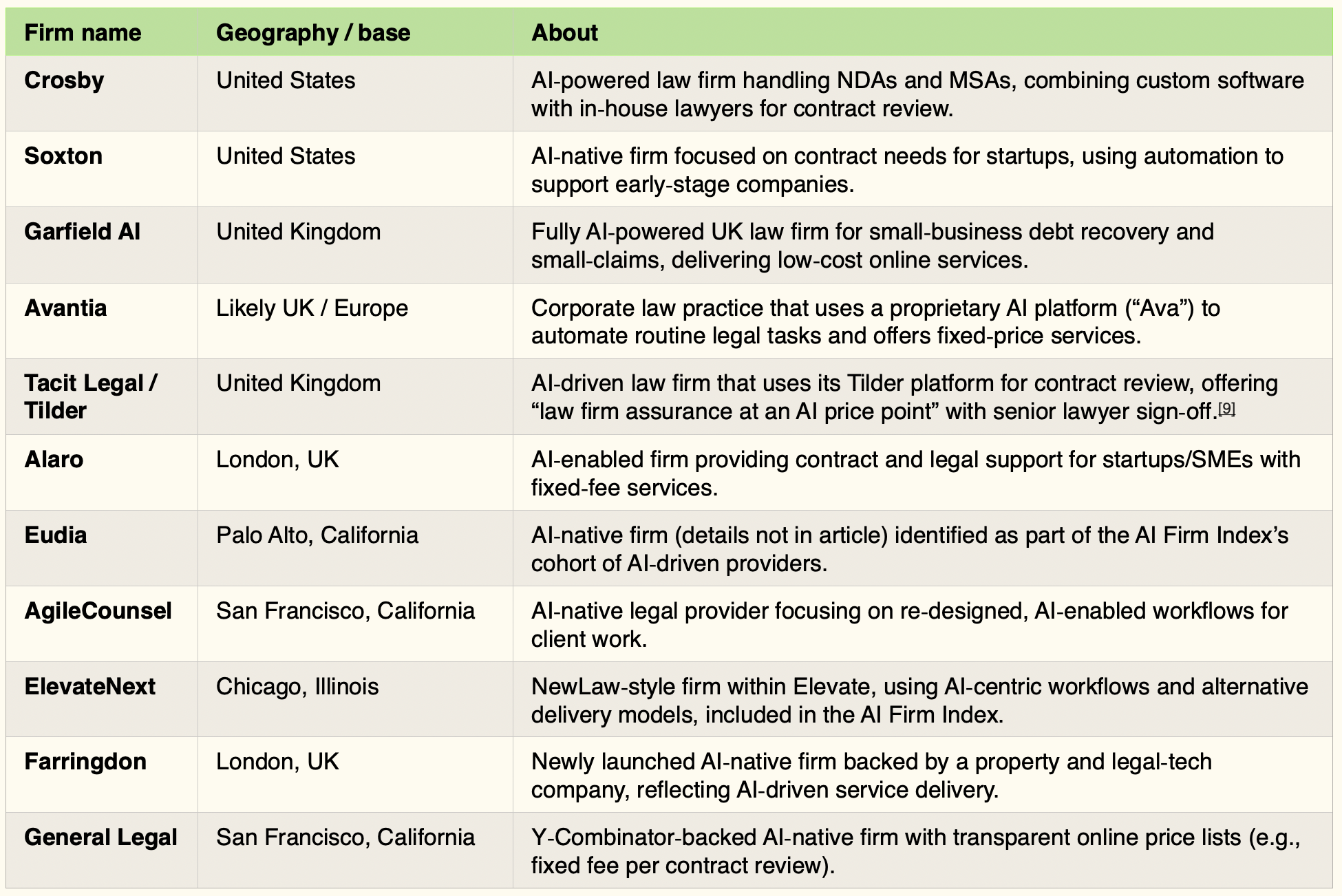
These are only the firms explicitly named in public articles and posts about the directory and about AI‑native law firms generally; the full40‑firm list is broader but not fully visible from the sources available here.
How AI‑native differs from “AI‑using” law firms
To crystallize the difference, we can compare typical patterns:
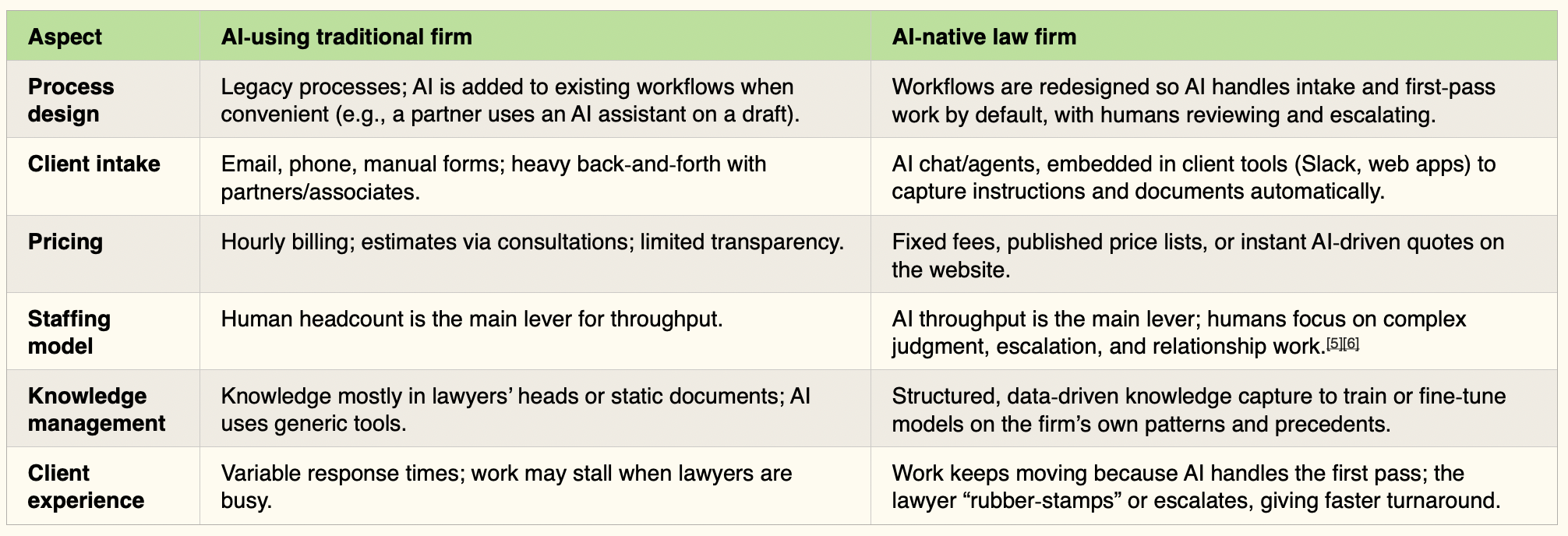
Using AI tools alone does not make a firm AI‑native; AI‑native status is about the operating model and client experience being AI‑centric from end to end.
Don't Miss the Latest LegalTech Updates
Get clear, current, and actionable global insights directly to your inbox.
Why this matters strategically for law and legal ops
For law firms:
- Competitive pressure: AI‑native players demonstrate how smallteams, supported by AI, can deliver at scale, challenging the assumption that“bigger is always better” in legal.
- Business model experimentation: they are experimenting with new fee structures (fixed,subscription, outcome‑based) that traditional firms willincreasingly have to respond to.
- Talent and culture: AI‑native firms recruit lawyers who arecomfortable collaborating with AI and working in product‑like environments, which may influence expectations across the profession.
For in‑house teams and clients:
- Better fit for AI‑native businesses: if a client isitself AI‑native, working with an AI‑native firm reduces friction becauseboth sides operate with similar speed and tooling expectations.
- Cost and speed: AI‑native firms can often deliverroutine work faster and at lower cost without sacrificing quality, making themattractive for high‑volume workstreams.
- Benchmarking:even if they do not switch providers, in‑house teams can use AI‑native models as benchmarks whenpushing legacy firms on efficiency, transparency, and innovation.
Updates by eLT.